

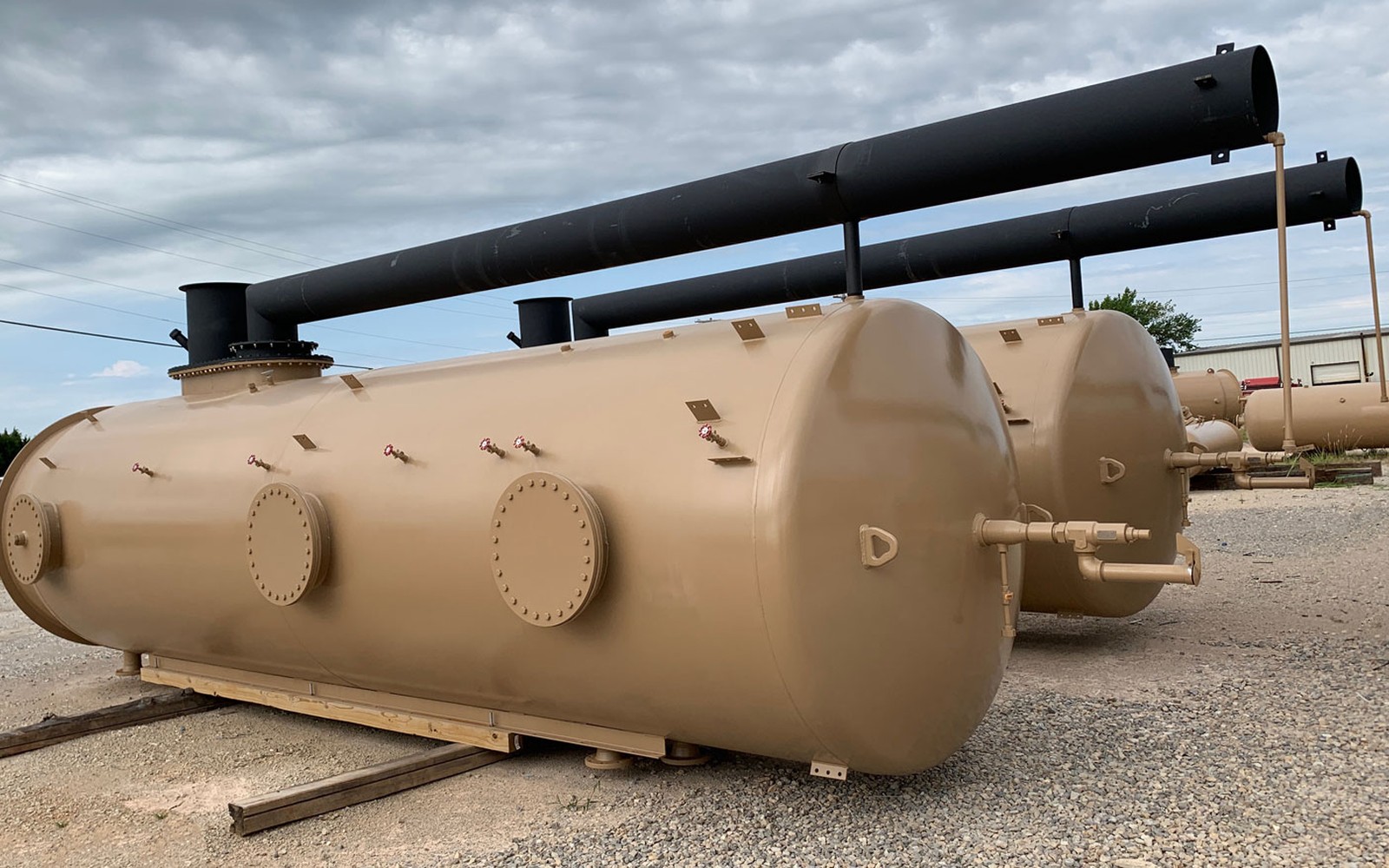
Heater Treater Financing
Finance heater treaters and oil treating units for oil dehydration and BS&W reduction at the wellsite. Loans, leases, and sale-leaseback for production.
Getting crude oil to pipeline spec is a production problem that a heater treater solves. A well producing crude with basic sediment and water (BS&W) above what the pipeline or gathering system will accept can't get to sales without treating the emulsion. The heater treater is the unit that applies heat and retention time to break that emulsion, separate the water, and deliver oil that meets the quality specification required for sale. In active oil-producing basins, a properly sized and functioning heater treater is not optional equipment; it's the last step between a producing well and revenue.
We finance heater treaters for producers who need treating capacity at individual well sites, production batteries, or central facilities. Transactions start at $50,000 and range to several million for large-capacity horizontal gun barrel type units and high-capacity vertical treaters used on multi-well batteries. We work with independent oil producers, production equipment rental companies, and midstream operators who maintain treating capacity as part of a gathering and handling system. The financing structure is designed for production equipment realities, not generic commercial lending assumptions.
Heater Treater Configurations and Their Financing Implications
Vertical heater treaters are the most common configuration for single-well or low-rate applications. A vertical unit in the 200 to 400 barrel-per-day treating capacity range is a standard size for the majority of onshore conventional oil well completions. The unit combines a firebox and heat coil that warms the emulsion, a settling section where treated oil separates from water, and a gas section that routes the liberated gas to the sales line or gas gathering system. Vertical treaters are compact and can often be trailer-mounted for quick deployment and relocation.
Horizontal gun barrel treaters are used for higher-rate production and for crude with difficult-to-break emulsions that require longer retention time. A horizontal treater with two or three sections (typically a free water knockout section, a heating and treating section, and an oil settling section) provides more contact time and separation surface than a vertical unit of equivalent diameter. High-capacity horizontal units used on multi-well production batteries may process thousands of barrels per day and represent significant capital investment. The fire tubes, flue systems, and internal electrostatic grids (on electrostatic treaters) are all mechanical components that require periodic inspection and maintenance, and their condition affects both the operational status of the unit and its secondary market value.
- Vertical treaters: 50 to 500+ BPD capacity; most common for single-well applications
- Horizontal gun barrel treaters: higher-rate processing with greater retention time
- Electrostatic treaters: use electric field to accelerate emulsion breaking; common in heavy crude applications
- Fire tube condition, burner system, and chemical injection points are key inspection financing paths on used units
What Heater Treater Transactions Qualify for Financing
New heater treaters purchased from manufacturers such as National Oilwell Varco, Sivalls, and other ASME-certified pressure vessel fabricators come with a clear provenance, current manufacturer documentation, and a financing profile that any experienced oilfield equipment lender can evaluate. The unit's ASME pressure vessel rating, the BTU capacity of the firebox, and the designed treating rate are the key specifications.
Used heater treaters from the secondary market or from production companies that are selling surface equipment represent most of the transaction volume in this category. A treater that has been in service on an active production facility, maintained properly, and has documented fire tube inspections is a solid financing asset even if it's ten or fifteen years old. The secondary market for used heater treaters is active in Texas, Oklahoma, Wyoming, and the Appalachian region, and units that have been pulled from service and cleaned out are routinely financed for redeployment. What creates difficulty is a unit with undocumented fire tube history, a firebox that needs replacement, or a vessel that hasn't been pressure tested since its last major maintenance. Addressing those issues before financing, or including the remediation cost in the deal, is the practical approach when the unit otherwise has good utility. Operators working in Hobbs, NM and Casper, WY run both vertical and horizontal treater configurations depending on the producing formation, and both sizes are well-supported by the financing market.
Financing Terms for Heater Treater Transactions
Heater treater financing typically runs on three-to-five-year terms for used equipment and up to seven years for new units. Down payment requirements parallel what we see on other production equipment: 10 to 15 percent for clean credit situations, 20 to 30 percent for B/C credit or older equipment. Short-form financing up to $400,000 is available for transactions where the credit profile is reasonable and the equipment documentation is complete. A single vertical heater treater in the common production size range often falls within the short-form threshold.
Larger transactions, such as financing a complete production battery installation that includes the heater treater, separator, and associated storage tanks, require full financial documentation. These deals benefit from the same lender panel we use for separator financing: lenders who have actually looked at oil treating equipment and understand that a properly specified and maintained heater treater has a long operational life and a stable secondary market. A rental company that finances a fleet of heater treaters of various sizes and deploys them to operators across a basin should explore whether an equipment leasing structure or a Equipment Sale-Leaseback on existing inventory provides better capital efficiency than individual loan transactions for each unit. If you own heater treaters with existing notes, an equipment refinance can reduce monthly payments and free cash flow for additional inventory acquisition.
Questions before you send the file.
Straight answers about heater treater financing, documentation, timing, and equipment eligibility.
Can I finance a heater treater if the fire tubes need replacement at purchase?
A heater treater with fire tubes that need replacement is financeable if the deal is structured to account for the remediation cost. One approach is to reduce the purchase price by the fire tube replacement cost and finance the net amount. Another approach is to include the fire tube replacement in the total financing package if the overall amount justifies it. What doesn't work is financing the unit at full value as if it were in service-ready condition when it isn't.
We lease heater treaters to oil producers on six-month or annual rental agreements. How do lenders evaluate our revenue model?
Production equipment rental on short-to-medium term contracts is a recognized business model that oilfield equipment lenders understand. Diversification of the customer base matters: a rental company with ten customers in a basin has better revenue stability than one dependent on a single producer. Three to six months of rental revenue deposits on bank statements, along with the rental agreements themselves, demonstrate the business case. Oilfield equipment rental companies are a profile our lender panel works with regularly.
Can I finance an electrostatic heater treater, and do lenders treat them differently from standard thermal treaters?
Electrostatic heater treaters are financeable. Lenders evaluate them on the same collateral basis as conventional thermal treaters: ASME rating, treating capacity, age, and condition. The electrostatic grid and power supply components add complexity to the inspection checklist, but the underlying value of the pressure vessel and firebox system is similar to a conventional treater of the same size. Electrostatic units command premium prices when in good condition because they handle difficult emulsions that standard thermal treatment can't break efficiently.
We're a small producer and want to finance a 100 BPD vertical heater treater. Is the deal size too small?
Our minimum is $50,000. A new 100 BPD vertical treater from a fabricator is often running about $80k to $150k depending on the pressure rating, firebox BTU specification, and the manufacturer. That puts it comfortably within the application-only financing range. A used unit of the same size may cost less, but it's still above the minimum threshold in most cases. Small-volume producers are a normal part of our deal flow, and the application-only path means you don't need three years of tax returns to qualify.
Can I bundle a heater treater with a separator into a single financing deal?
Yes. A complete production package including a separator and heater treater is a practical bundle when both units are part of the same installation and the total amount justifies the deal structure. Each vessel needs its own ASME documentation and title, but they can be financed together in a single facility. If the total package is above the application-only threshold, full financial documentation will be required, but the deal itself is structured as a single production facility acquisition. See our separator financing page for the parallel discussion on the separator side of that same installation.
Quote desk
Get terms on Heater Treater Financing.
Send the asset details, seller quote, and target timing. We will review the request and tell you what documentation is needed next.