

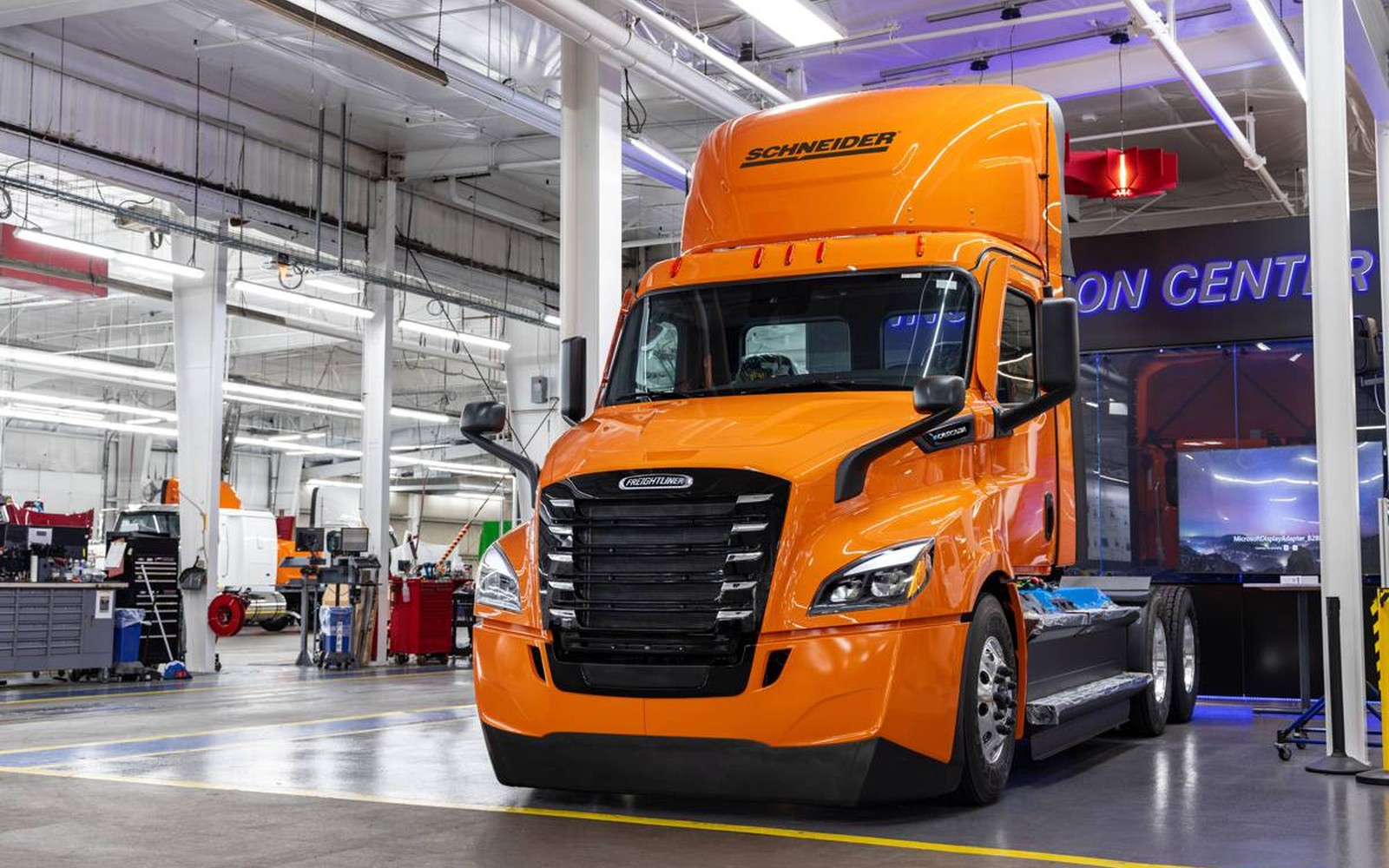
Freightliner Financing for Oilfield Trucks
Finance Freightliner 114SD and vocational trucks for oilfield service. Vacuum trucks, sand haulers, and fluid transport. $50k minimum, B/C credit OK, funded in.
Freightliner's 114SD established itself as the oilfield vocational workhorse through a combination of accessible service networks, competitive spec flexibility, and a frame-and-suspension package that holds up under oilfield body weights and off-road operating conditions. The 114SD sits at the center of the produced water hauling market in the Permian Basin and DJ Basin, where the combination of aggressive payload ratings and Cummins or Detroit Diesel power options makes it a consistent operator choice for both vacuum truck and tanker body applications.
A Freightliner 114SD outfitted for vacuum service or produced water hauling typically prices between $140,000 and $200,000 depending on tank size, pump configuration, and axle spec. We finance Freightliner oilfield trucks starting at $50,000. Short-form approval covers transactions up to approximately $400,000 on qualified deals. Most deals fund in one to two weeks. Saltwater disposal operators adding trucks as new SWD wells come online, and oilfield service companies replacing aging units, operate in a window where the contract is awarded before the truck is in hand. Financing that closes in days matters in that environment.
Freightliner Models We Finance for Oilfield Work
The primary Freightliner platform we finance for oil and gas service is the Freightliner 114SD. The 114SD is Freightliner's severe duty vocational truck, designed for high-GVW applications in demanding environments. Key features relevant to oilfield use include its set-back front axle option (preferred for oilfield body mounting and weight distribution), frame rail strength for heavy body and PTO loads, and engine options spanning Cummins X12 and X15 as well as Detroit DD13 and DD15 units.
Beyond the 114SD, we also finance:
- Freightliner Cascadia class-8 tractors for line-haul frac sand and oilfield commodity transport on paved routes between basins
- Freightliner M2 106 medium-duty units in oilfield lube truck, light service, and hotshot configurations
- Freightliner 122SD for ultra-heavy vocational applications including specialized oilfield haul
Freightliner trucks with oilfield body equipment are financed as complete configured units. A 114SD with a 4,000-gallon vacuum tank, transfer pump, and rear piping is a different asset than a bare cab-chassis, and we value the complete truck rather than stripping the body from the collateral calculation.
Applications We Fund
Freightliner oilfield trucks serve a range of applications, and we finance across all of them.
Produced water and vacuum service: The 114SD is the reference truck for produced water hauling in the Permian Basin. Operators running SWD routes between wellheads and saltwater disposal facilities in Midland, Odessa, and the surrounding Delaware Basin area maintain Freightliner-heavy fleets. Vacuum truck operators cleaning reserve pits, vacuum-transferring fluids, and hauling drilling mud also run the 114SD in significant numbers.
Frac water delivery: Freightliner Cascadia tanker combinations delivering fresh water to frac sites during completions activity. Water sourcing and delivery contracts during completion operations create burst demand for tanker trucks, and operators serving that market need financing that matches the pace at which operators award work.
Oilfield service trucks: Freightliner M2 and similar configurations for lube routes, chemical delivery, and light service work around production sites. These smaller assets sometimes fall below the sweet spot of larger lenders but are solidly within our financing range.
Sand and commodity hauling: Freightliner Cascadia tractors pulling sand trailers on routes from mines to frac spreads in the Permian, DJ Basin, and Eagle Ford. High-cycle sand routes accumulate mileage quickly; a Cascadia at 500,000 miles on a sand run is not automatically ineligible for financing. We look at condition and market value, not just mileage.
How Fast We Close
The oilfield moves faster than most lenders. A basin activity uptick runs on a compressed timeline, and contracts are awarded to operators who can field equipment, not to operators who are waiting on approval committees. Our application process is designed for that reality.
For transactions up to approximately $400,000, the file is an application and recent operating statements. Approvals come back in days. Funding happens after the approval, typically completing the full cycle in one to two weeks from initial submission. There is no extended back-and-forth if the application is clean and the asset documentation is in order.
Fleet deals with multiple Freightliner units process on the same timeline as single-truck deals when the documentation is organized. If you are buying three 114SDs in a single transaction, provide the information for all three units together and the underwriting runs in parallel rather than sequentially.
Operators in markets like Williston who see Bakken activity spike need trucks on the ground fast. Operators in Casper chasing Powder River Basin work face the same dynamic. We have funded Freightliner transactions in both markets when the application came in clean and the deal made sense.
Refinancing Freightliner Trucks You Already Own
Freightliner 114SDs owned outright represent equity that can be put back to work. Two routes are common.
Cash-out refinancing is a loan against the truck's current value. If you own a 114SD vacuum truck worth $80,000 free and clear, a refinance can return $50,000 to $65,000 in cash while the truck stays on your routes earning revenue. That capital can fund a down payment on a second truck, cover a slow period without touching operating reserves, or pay for repairs on other fleet units.
A Equipment Sale-Leaseback is more aggressive. The truck is sold to the lender and leased back under a structured payment, releasing more of the asset's value as cash. The operator continues running the truck as if they own it, with lease payments replacing what was equity. Sale-leaseback on Freightliner oilfield trucks is structured around actively working units, not parked or out-of-service equipment. The truck needs to be earning or the transaction does not make sense for either side.
Operators considering equipment refinancing on existing Freightliner debt can also extend terms or restructure rates when current obligations are creating cash flow pressure between contracts.
Questions before you send the file.
Straight answers about freightliner financing for oilfield trucks, documentation, timing, and equipment eligibility.
Can I finance a Freightliner 114SD that has a Cummins X15 and was recently re-powered? The original engine had issues.
Yes. A re-powered truck is actually a cleaner asset in some respects, assuming the re-power was done properly with a new or low-hour engine and documentation. We want to see the re-power invoice, the engine hours on the replacement unit, and a current inspection. An X15-powered 114SD with a documented re-power is a financeable asset.
My Freightliner 114SD vacuum truck was bought at auction with a salvage title. Is that financeable?
Salvage titles significantly complicate collateral valuation and most conventional lenders decline them. It is not impossible, but we would need to see a full condition inspection, a detailed repair history, and documentation that the truck passed applicable state inspection requirements. The loan-to-value would be lower to reflect the title status.
I want to buy two Freightliner 114SDs from a dealer and take delivery in 60 days when they come off the production line. Can I get approved now?
Pre-approval for future delivery works well. We can issue a conditional approval based on your credit profile and the dealer's build order or configuration sheet. Final funding is triggered when the trucks are ready for delivery, and the approval documents the terms in advance so there are no surprises at closing.
Can I use a TRAC lease structure for Freightliner oilfield trucks instead of a standard loan?
Yes. A TRAC lease puts a terminal rental adjustment clause on the back end, which can reduce monthly payments relative to a conventional loan. It works well for operators who want lower monthly payments and are willing to accept exposure on the residual value at the end of the term. The truck is used collateral during the lease and you are responsible for any gap between the guaranteed residual and actual market value at lease end.
Quote desk
Get terms on Freightliner Financing for Oilfield Trucks.
Send the asset details, seller quote, and target timing. We will review the request and tell you what documentation is needed next.