

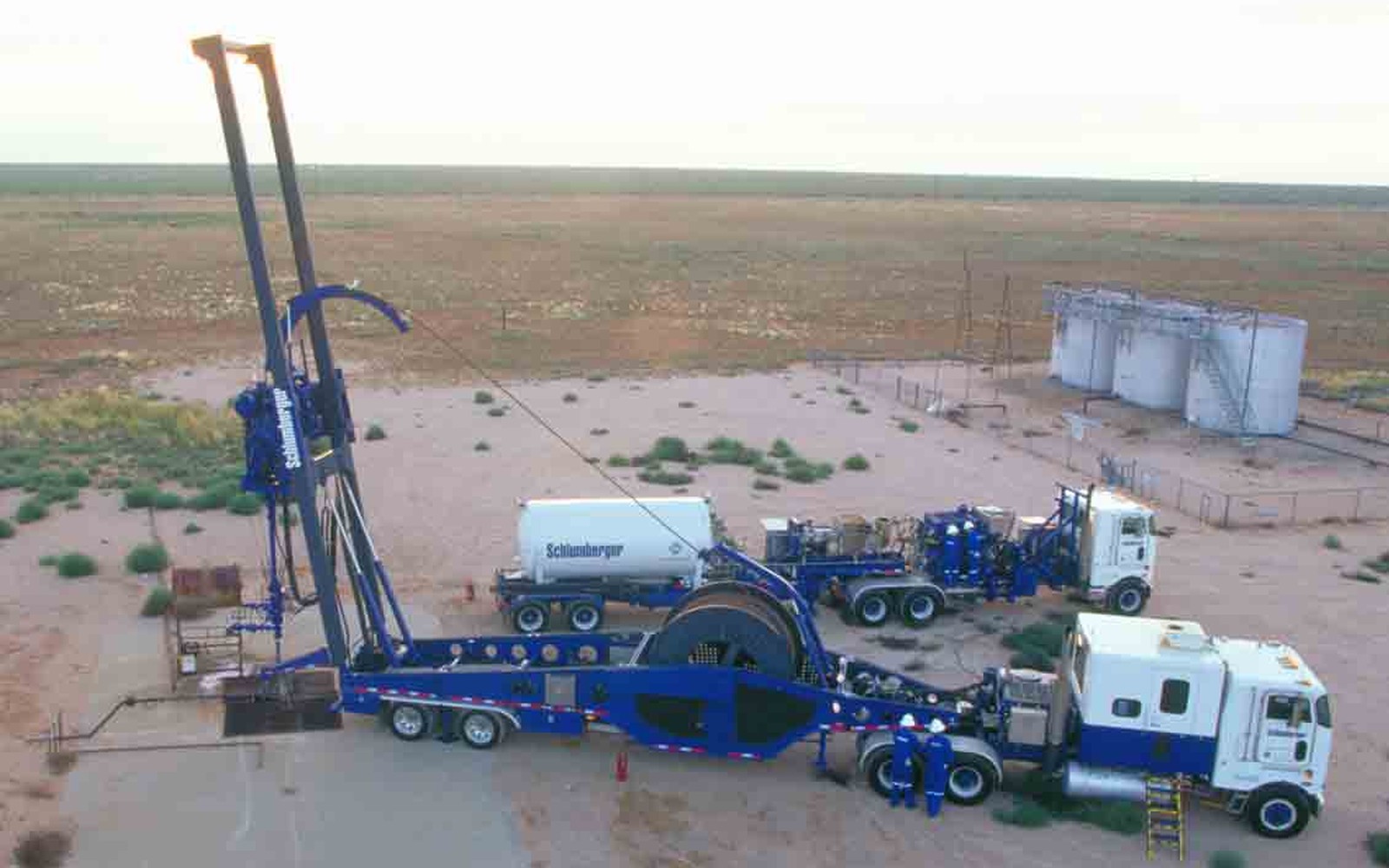
Coiled Tubing Companies
Coiled tubing unit financing for oilfield service contractors. Short-form up to ~$400k, closing after field-ticket review, B/C credit welcome. Request a quote.
Coiled tubing work is contract-driven, and the contract window does not wait for a lender who takes six weeks to underwrite a deal. Operators in the Permian, DJ Basin, and Appalachian plays expect CT crews to mobilize within days of a job award, and the companies that can do that consistently are the ones that build long-term relationships with E&P clients. Fielding that capability means having the unit, the reel, and the BHA equipment ready before the call comes.
We finance coiled tubing units across the full size range, from 2-inch OD coil on a light-duty skid suited for cleanouts and nitrogen kicks all the way up to heavy 2 3/8-inch or 2 7/8-inch coil units built for deep completions work in high-pressure wellbores. A modern coiled tubing spread with the power pack, injector head, control cabin, and reel can run $800,000 to more than $2 million new. Used units from reputable service companies typically range from $300,000 to $800,000 depending on coil size, footage remaining on the reel, and the vintage of the surface equipment.
Our minimum transaction is $50,000. Short-form approvals cover deals up to roughly $400,000, which reaches a good portion of the used-CT market. Larger packages require recent operating statements and recent tax returns, but the process moves fast and funding typically closes in one to two weeks. We finance new equipment, used equipment, and refinances of units already working in your fleet.
Coiled Tubing Equipment We Finance
A coiled tubing spread has several financeable components that we can structure as a single package. Lenders who specialize in oilfield assets understand that the unit, the reel, the power pack, and the trailer are a system, not four separate pieces of equipment. We work with those lenders specifically because they underwrite the full spread at appropriate collateral values.
- Coiled tubing units (truck-mounted, skid-mounted, or trailer-mounted) in OD sizes from 1.5 inch to 2 7/8 inch
- Power packs with diesel prime mover driving a hydraulic system rated for the injector head
- Injector heads sized for the coil OD in service
- Reel assemblies, including complete reels with footage remaining well documented
- Fluid pumping equipment paired with the CT unit for stimulation or cleanout applications
- Support trucks and crane trucks used in CT operations
Companies financing new units should ask us about Section 179 expensing and bonus depreciation. CT units placed in service within a tax year may be fully expensable under current rules, which changes the effective cost of ownership significantly. We are not tax advisors, but we structure deals specifically so you can discuss the tax treatment with your CPA before closing.
For companies with existing CT units on the balance sheet, a sale-leaseback on owned equipment is worth evaluating. You transfer the unit into a leaseback facility at market value, lease it back on a fixed monthly payment, and the proceeds go to working capital or into a second unit. Many CT operators have used this structure to fund fleet expansion without going back to a bank.
Credit and Documentation for CT Companies
Coiled tubing companies span a wide credit range. Owner-operators running a single unit on a preferred-vendor contract with one E&P client are different borrowers than a regional CT contractor running eight spreads across three basins, and we underwrite accordingly.
For companies with solid bank balances and clean credit, deals up to $400,000 close on the application alone. No financials, no tax returns, no P&L. You fill out the application, we verify the equipment details, and we submit to lenders. Approvals on short-form deals typically come back within 24 to 48 business hours.
For larger transactions, or for companies with credit events in their history, we ask for three months of bank statements. Revenue does not have to be enormous; lenders look for consistent cash flow relative to the proposed payment, not a specific revenue threshold. A company generating $350,000 to $400,000 in annual revenue can generally support a $200,000 to $250,000 CT unit loan if the cash flow pattern is steady.
B and C credit are in scope here. Oilfield service companies that carried debt through the 2020 downturn or faced payment deferrals are not automatically disqualified. We present deals to lenders who understand the service sector's cycle and evaluate credit history in context. oilfield challenged-credit financing for CT companies often requires a larger down payment (20 to 30 percent rather than 10 to 15 percent), but approval is achievable in most cases where the business is genuinely operating and generating revenue.
Related Equipment and Services
Coiled tubing companies often pair their CT spread with complementary equipment. We finance the full range of oilfield service assets, so you can package multiple pieces in one application rather than applying separately for each. Common companion assets include nitrogen pumping units for gas lifting and pressure operations, fluid-pump trucks for stimulation work, and light-tower and generator sets for remote location support.
Many CT contractors also handle well servicing work when CT jobs are between contracts, which means a workover rig or well-service rig is part of their fleet. We finance those assets on the same terms and through the same process as the CT unit itself, and a combined application for two pieces of equipment is handled as a single package where the combined transaction warrants it.
Companies operating in established plays like the Permian or mid-continent Oklahoma need equipment that can move quickly between well locations. Wireline companies often work alongside CT crews on the same jobs, and wireline companies face the same rapid-mobilization financing requirements we address for CT operators.
Questions before you send the file.
Straight answers about coiled tubing companies, documentation, timing, and equipment eligibility.
Can I finance a coiled tubing unit I found from a service company that is selling off part of its fleet?
Yes. Fleet-reduction sales from larger service companies are a common source of used CT equipment, and we finance those transactions through our private-party and used-equipment programs. You need the equipment details, a bill of sale or purchase agreement, and we handle the rest.
The coil on our unit needs to be respooled or partially replaced. Does that affect financing?
Lenders will factor remaining coil footage and condition into the collateral valuation. A unit with significant coil remaining commands better loan-to-value terms than one that is near end-of-reel life. If you are buying a unit that needs new coil, factor that into your total project cost and let us structure the deal accordingly.
We have two existing CT units financed elsewhere. Can we refinance both into a single payment?
Yes. Consolidating multiple oilfield equipment notes into a single loan simplifies cash flow management. We structure refinances and consolidations regularly for CT companies carrying multiple separate notes. The terms depend on the combined equity across the two units and the outstanding balances.
My CT company is six months old. Is there any path to financing?
There is, though it is narrower than for seasoned operators. With less than twelve months of operating history, lenders want to see strong personal credit, a down payment of 25 to 30 percent, and evidence of contract revenue already on the books. Bringing an experienced CT operator on as an equity partner sometimes helps with approval as well.
Quote desk
Get terms on Coiled Tubing Companies.
Send the asset details, seller quote, and target timing. We will review the request and tell you what documentation is needed next.