

Sand Hauler Financing
Finance sand hauler trucks for frac sand transport operations. End dump, belly dump, and pneumatic trailers. Loans, leases, and TRAC leases. B/C credit.
Frac sand hauls run on tight windows. A completion program schedules sand deliveries around stage pacing, and a driver who can't make the call gets replaced by one who can. The operators who hold sand hauling contracts in active Permian Basin or Midland Basin programs have discovered that consistent delivery capability, not just the ability to haul load, is what keeps a customer relationship intact. Every truck that goes down on a haul day is a conversation with the operator and a risk to the next contract renewal.
We finance sand hauler trucks in all the common configurations: end dump semis for bulk silica delivery, belly dump trailers for high-volume programs, and pneumatic tank trailers that transfer sand directly into on-location silos. Minimum deal size is $50,000, with most single-truck transactions running from $90,000 to $250,000 depending on the chassis, trailer type, and age. We work with oilfield trucking companies that haul exclusively for frac operators as well as diversified carriers that include sand haul work in a broader freight mix.
Sand Hauler Truck Configurations and Their Financing Implications
The choice of trailer configuration determines which sand delivery programs a hauler can access. End dump trailers are the most common and versatile configuration for frac sand delivery: a standard end dump can deliver to a receiving hopper at a silo base or directly to a transloading point with minimal site infrastructure. End dump trailers used for frac sand hauls are typically aluminum or steel-framed units in the 40 to 44-foot range, with either a manual or electric tarp system for load security during transit.
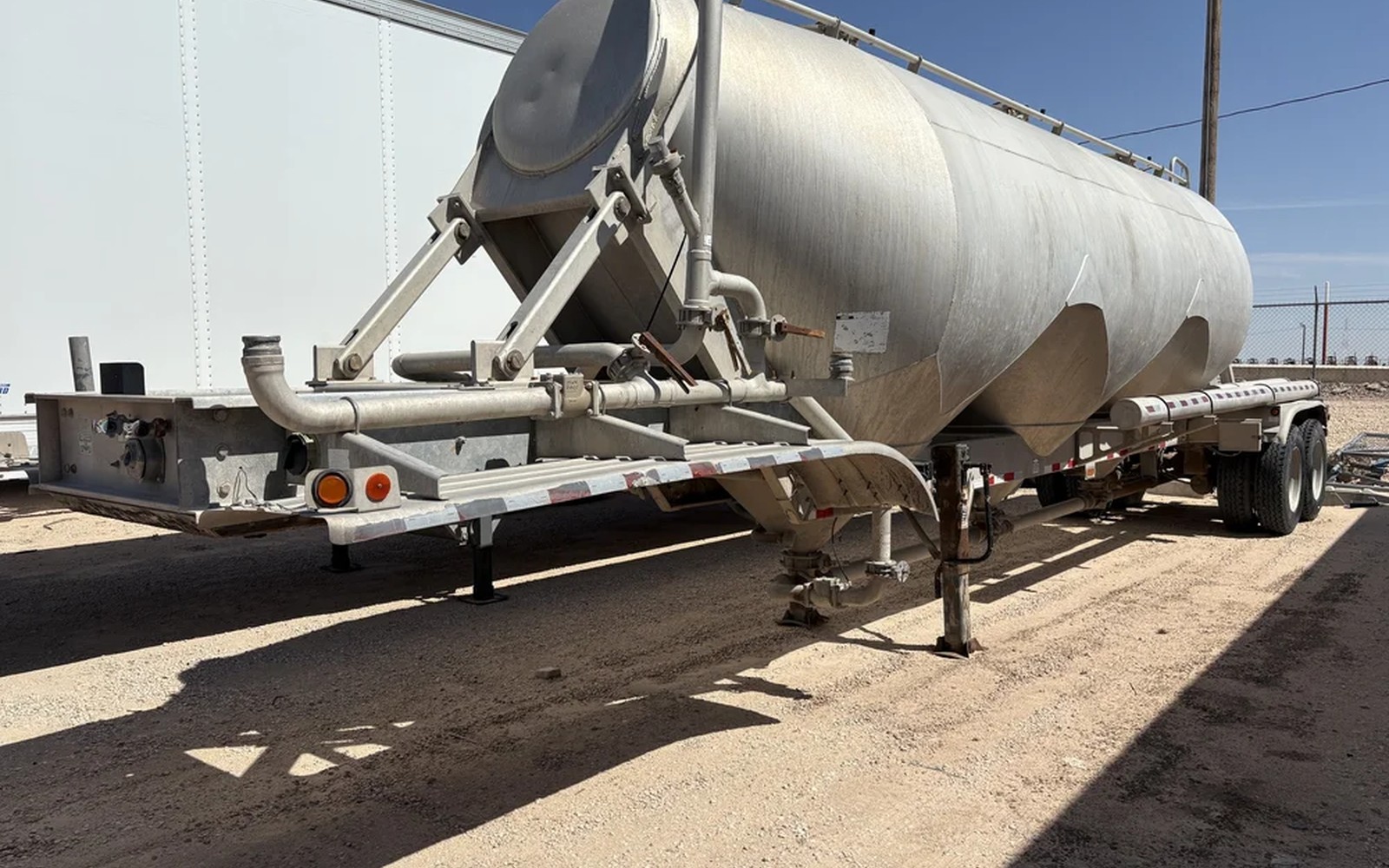
Belly dump trailers deliver sand from a center gate directly onto a conveyor or into a receiving bin and are popular on programs where cycle time matters because they unload faster than end dumps. Pneumatic tank trailers move sand through pressurized transfer into closed silos and are used on programs where dust control is required or where the silo system can only accept pneumatic delivery. Pneumatic trailers require a compressed air system (either truck-mounted or external) and command higher day rates when their specific delivery mode is required.
- End dump: most versatile; 40-44 ft aluminum or steel frame; common for general frac sand haul
- Belly dump: faster cycle time; used on high-throughput programs with compatible receiving systems
- Pneumatic tank: closed system transfer; required for dust-sensitive sites and closed silo filling
- Chassis specifications: Class 8 tractors with high-horsepower engines handle loaded gross weights on rural lease roads
Lease road conditions in active oilfield areas accelerate wear on both the tractor and trailer. A sand hauler that runs consistent lease roads in the Delaware Basin or Midland Basin accumulates frame stress and suspension wear faster than an equivalent truck running paved highway miles. Lenders who work oilfield truck deals factor in the operating environment when evaluating advance rates on used equipment.
Financing Terms for Sand Haulers
Sand hauler truck financing for a tractor-trailer combination typically runs on three-to-five-year terms. Trailer-only financing on a new trailer purchase may support up to seven years. Down payment requirements are often lower on truck financing than on oilfield specialty equipment because the collateral is familiar to a broader range of lenders: a Class 8 truck tractor has a deep secondary market, and even a specialized end dump trailer can be remarketed outside the oilfield if the original operator stops haul work.
A TRAC lease is a common structure for sand hauler trucks because it allows the operator to set a terminal rental adjustment clause (the residual value at end of term) that matches their expected use and resale plan. TRAC leases can offer lower monthly payments than a straight loan on the same equipment, and the terminal clause gives the operator flexibility at lease end. Operators with clean credit and established sand haul revenue often qualify for competitive TRAC lease terms even on older, high-mileage trucks, because the commercial paper market for Class 8 equipment is active regardless of mileage when the chassis and drivetrain are in good condition. For operators building a first truck or moving from solo operator to a two-truck haul business, startup financing options cover the entry point even without a multi-year track record.
Sand Haulers Who Use This Financing
Single-truck operators entering the frac sand haul market on a dedicated contract make up a significant portion of our sand hauler deals. The dynamic is straightforward: an operator secures a haul agreement with a frac company or a sand logistics provider, then uses that contract as the business case for financing the truck. The contract doesn't guarantee approval, but it demonstrates the revenue basis for the monthly payment and gives a lender context for the borrower's business model.
Multi-truck hauling companies adding to their fleets represent the second major profile. These companies often have established sand haul relationships in basins like the Permian or in Pecos, TX and want to add one or two trucks to cover additional delivery capacity. Short-form financing up to $400,000 covers the typical two-truck addition for a company with reasonable credit and active haul revenue. Companies based near major sand transloading hubs in San Antonio, TX or in eastern New Mexico often have natural access to multiple frac operators that makes their revenue more stable than a hauler dependent on a single customer in a single basin.
Questions before you send the file.
Straight answers about sand hauler financing, documentation, timing, and equipment eligibility.
Can I finance a sand hauler truck if I have a pending haul contract but haven't started operations yet?
A pending or committed contract helps your application significantly even before operations start. Lenders want to understand where the truck's revenue will come from, and a signed contract or letter of intent from a frac operator or sand logistics company answers that question. Down payment requirements may be slightly higher for pre-revenue startups, and personal credit plays a larger role in approval, but it's an approvable situation when the contract is solid and the credit is reasonable.
How does high mileage on a tractor affect financing terms for a sand haul truck?
High mileage on a Class 8 tractor compresses the financing term rather than making the deal impossible. A 2019 Kenworth T800 with 600,000 miles may support a three-year term where a similar truck with 200,000 miles might get five years. The lender sets the term to match the expected remaining economic life relative to the amount being financed. Engine history (is it original or has it had a major rebuild?) and the condition of the drivetrain are as important as raw mileage.
Can I finance a pneumatic tank trailer separately from my tractor?
Yes. A pneumatic trailer can be financed as a standalone transaction separate from the tractor. Trailer-only financing is a standard product for commercial equipment lenders. The trailer needs clear title and a complete description (manufacturer, year, capacity in cubic feet, delivery PSI rating). Pneumatic trailers used for frac sand delivery are recognizable to oilfield-experienced lenders and carry decent secondary market value, particularly in active basins.
We have a few missed payments from 2020 on a previous truck loan. Will that disqualify us?
Not automatically. B/C credit situations including delinquencies from the 2020 oil and gas downturn are common in the oilfield service sector, and lenders who work this market evaluate them differently than a general commercial lender would. What matters is the current trajectory: payments current now, active revenue, and a reasonable equity contribution go a long way toward offsetting a 2020 credit issue. B/C credit financing options exist for exactly this profile.
Is it possible to finance the tractor and trailer as a package if they have different ages?
Yes. Tractor-trailer packages with different ages are financed routinely. The term is typically set to the life of the shorter-lived component, which is usually the older piece of equipment. The combined package value is used for the advance amount calculation. If the age gap is significant (e.g., a 2024 tractor with a 2015 trailer), the lender may treat them as separate but concurrent transactions with different terms, or bundle them with a blended approach.
Quote desk
Get terms on Sand Hauler Financing.
Send the asset details, seller quote, and target timing. We will review the request and tell you what documentation is needed next.