

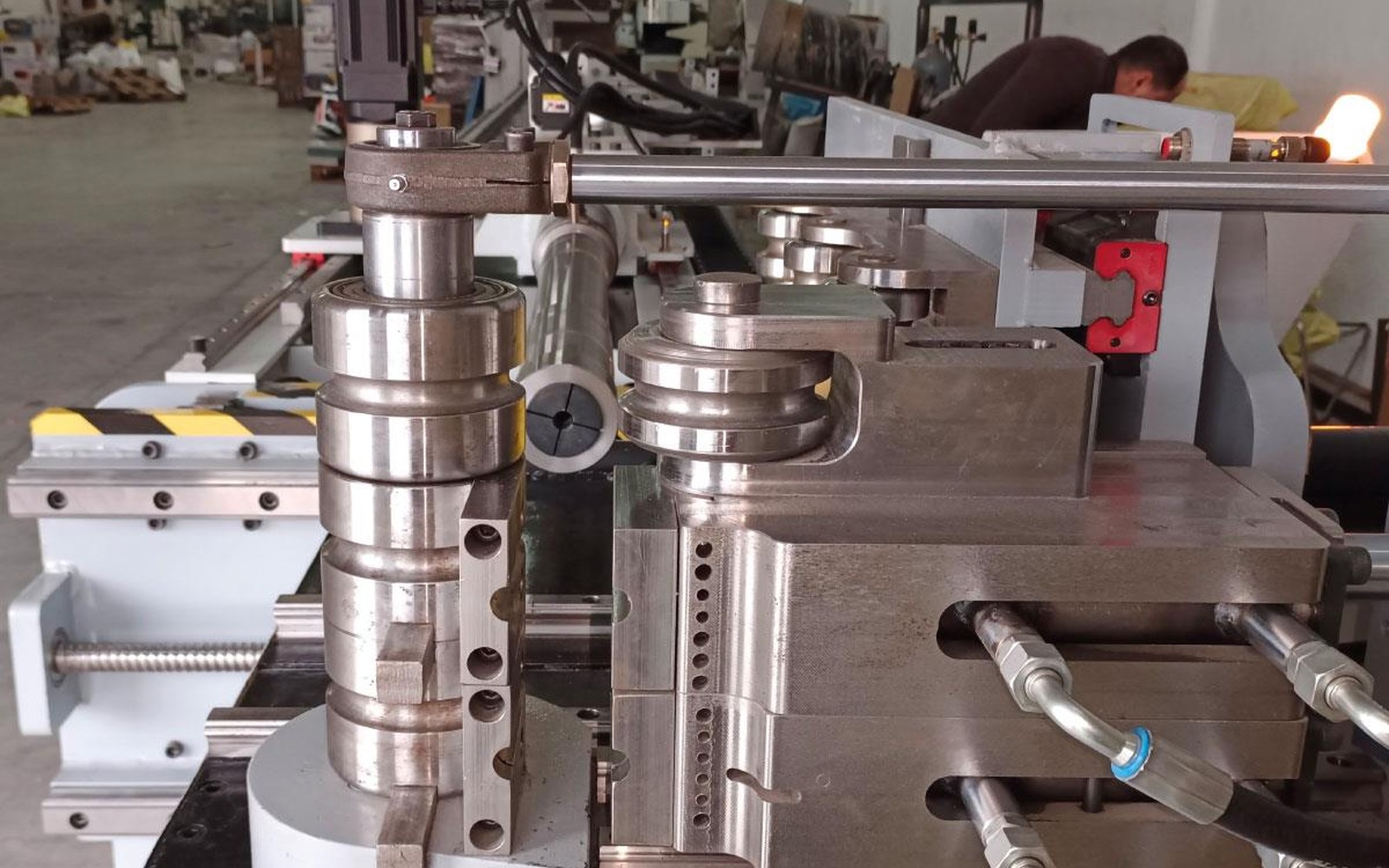
Pipe Bending Machine Financing
Finance pipe bending machines for pipeline construction. Cold bending machines for mainline and gathering systems. $50k minimum, fast approvals, B/C credit.
Every pipeline route has curves, grade changes, and tie-in geometry that require field bends. The contractor with a pipe bending machine on the spread produces those bends efficiently, on spec, and without waiting on a fabrication shop. A contractor renting bending equipment or subcontracting bends to another company loses margin and schedule control on every one of those bends. Owning the iron and financing it intelligently is what keeps the margin inside your operation.
Pipe bending machines used in oilfield and gas pipeline construction are cold-bending machines that use hydraulic force to bend pipe to a required angle without heating the material. These machines are typically skid-mounted or trailer-mounted for field mobility, rated for specific diameter and wall-thickness ranges. Common configurations handle pipe from 4 inches up through 48 inches in diameter, depending on the machine's rated bending force. Machines rated for large-diameter pipe (24 inches and above) are specialized and carry higher prices, from roughly $200,000 for mid-range models to over $500,000 for large-diameter, high-tonnage units with modern CNC angle controls. Smaller, versatile machines for gathering and distribution work are available from around $60,000 used. We finance from $50,000 with short-form processing to approximately $400,000.
Field pipe bending machines are essential tools for pipeline contractors performing bends to accommodate horizontal and vertical curves, road crossings, valve station tie-ins, and mainline tie-ins where geometry requires angular adjustment of the pipe run.
What Lenders Evaluate on Pipe Bending Machines
Pipe bending machines are niche assets that a generalist equipment lender may not value correctly. Lenders familiar with pipeline construction iron understand that a well-maintained, properly rated bending machine in working condition has a real secondary market among pipeline contractors, fabrication shops, and oilfield construction companies.
Key collateral evaluation points:
- Rated bending force and maximum pipe diameter (these define the machine's market)
- Control system type: older mechanical/manual units versus current CNC-controlled units with digital angle readout
- Hydraulic system condition and pump capacity
- Skid or trailer chassis condition
- Bend die sets included with the machine (die sets are consumables but a full set of matched dies for common pipe sizes adds significant value)
Machines with CNC angle controls and bend documentation capability are increasingly required on regulated mainline projects where as-built bend records must be provided to the pipeline operator. A machine with documented angle-output capability is more marketable than a purely manual unit. This affects both utility and secondary-market value.
Used pipe bending machines sourced from construction company equipment dispersals, contractor retirements, and equipment auctions are a common transaction type. Used equipment financing is available, and we regularly close transactions on machines acquired through those channels.
Contractors Who Finance Bending Equipment
Mainline pipeline construction contractors adding bending capability to avoid subcontracting that work make up a significant portion of our pipe bending machine transactions. Gathering system contractors who run smaller-diameter pipe and need an efficient, mobile bending solution for the variety of directional changes a gathering network requires are another common applicant type.
Oilfield construction companies based in Midland and the broader Permian Basin regularly acquire pipe bending capability as the basin's gathering and saltwater disposal infrastructure continues to expand. Contractors in the Marcellus and Utica shale areas of Washington, PA and surrounding counties, where gathering system buildout has been sustained, are also frequent applicants.
Fabrication shops and specialty pipeline contractors who perform pre-fabrication bends for others, in addition to their own construction work, can qualify. The revenue from bending services for third parties strengthens the cash-flow case for the equipment and is a positive factor in the credit review.
Startup pipeline contractors with experienced principals who have field history in pipe bending, welding, or pipeline construction operations can apply through our startup financing program. The principals' field background is taken into account alongside the company's financial profile.
Refinancing and Sale-Leaseback Options
A contractor who owns a pipe bending machine free and clear has an asset that can be converted to working capital through a Equipment Sale-Leaseback. The machine is sold to the financing company and leased back at market terms, with the sale proceeds available for any business purpose including new equipment acquisition, project mobilization costs, or working capital.
Refinancing an existing note on a bending machine can lower the monthly payment by extending the term, or reduce the total interest cost by shortening it at a lower rate than the original note carried. If your current note was originated during a period of higher rates or tighter terms, a current-market refinance may generate meaningful monthly savings.
For contractors adding a pipe bending machine alongside other pipeline construction equipment purchases, we can bundle multiple assets into a single transaction, which simplifies documentation and creates a single payment for the combined fleet addition.
Questions before you send the file.
Straight answers about pipe bending machine financing, documentation, timing, and equipment eligibility.
Can I finance die sets and tooling along with the bending machine in a single transaction?
In many cases, yes. Soft costs and tooling can be bundled with the equipment purchase up to the application-only limit. Above that threshold, we look at the overall transaction structure. Die sets for specific pipe diameters are meaningful-value assets in their own right and are often included in the financed amount.
The machine I want is a manual unit without CNC controls. Does that affect my financing options?
It affects the appraised value because CNC units have a broader secondary market, but manual bending machines are financeable assets. The advance rate may be slightly lower on a manual unit compared to a CNC equivalent, but the transaction structure is the same. Describe the unit's current capabilities and we will assess accordingly.
We are buying a pipe bending machine from a contractor who is retiring. How does private-party financing work?
Private-party purchases are a common source for pipe bending equipment. We finance these transactions with a signed purchase agreement, the machine's specifications and serial number, and an independent inspection or appraisal in most cases. The process takes a few extra days versus a dealer purchase but is otherwise straightforward.
Can I finance a bending machine along with other pipeline equipment in one transaction?
Yes. Multi-asset bundles are handled where the total dollar amount and credit profile support a single package. Combining a pipe bending machine with welding equipment, support trailers, or other pipeline construction tools can be structured as a single approval for simplicity.
My pipeline construction company has one blemished credit year on the books. Will that prevent approval?
One off year, especially if it aligns with a recognizable industry or project cycle, is not a disqualifier. We look at the current bank statements and the overall trajectory. If the most recent twelve to eighteen months of bank activity show a recovered operation, the prior year carries less weight in the credit decision.
Quote desk
Get terms on Pipe Bending Machine Financing.
Send the asset details, seller quote, and target timing. We will review the request and tell you what documentation is needed next.